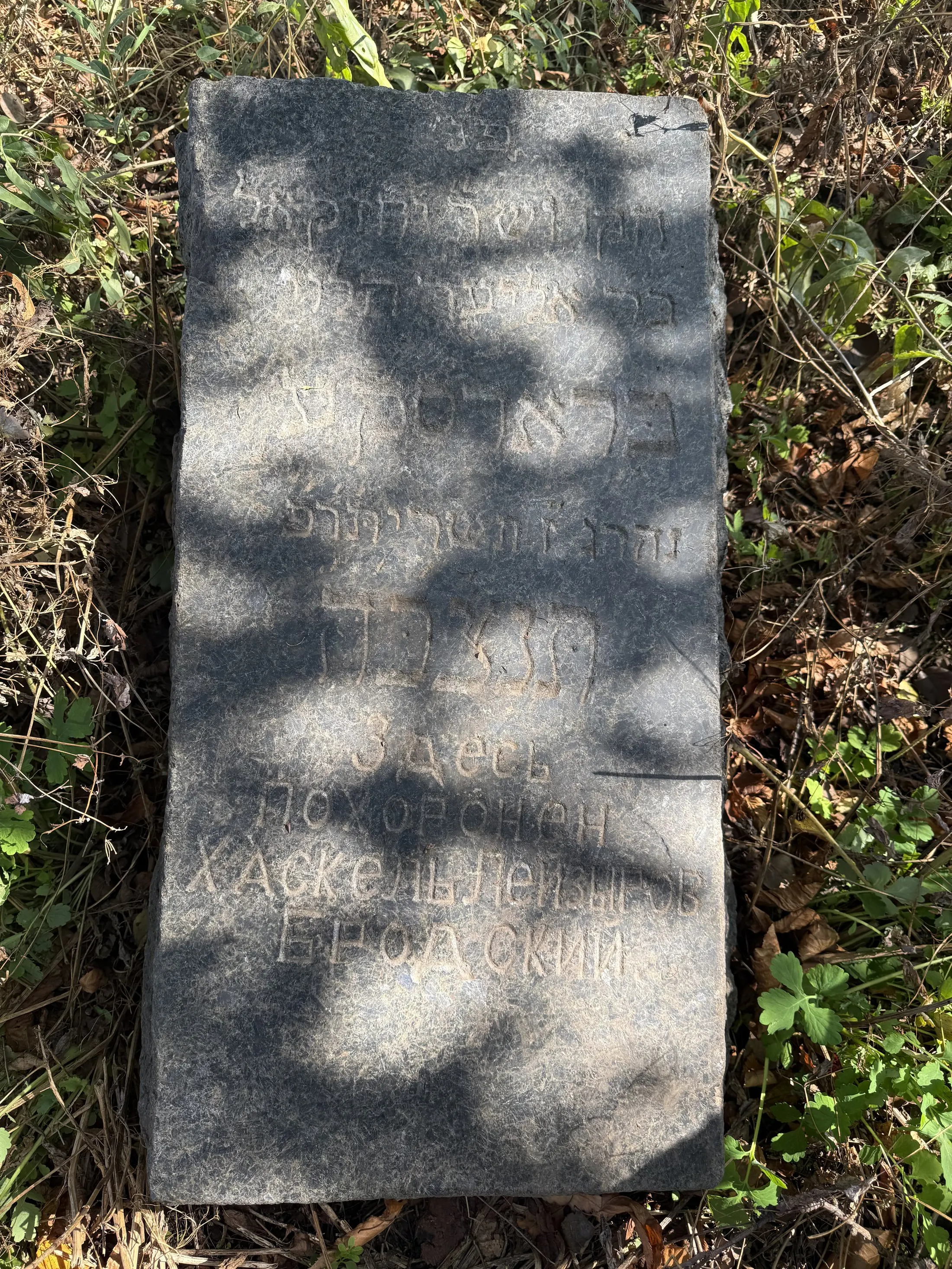
| Inscription | Translation | State |
|---|---|---|
| פ״נ | Here lies | legible |
| זקן וישר יחזקאל | an old and upright man, Yehezkel | preliminary reading |
| בר אליעזר | son of Eliezer | preliminary reading |
| בראדסקי | Brodsky | preliminary reading |
| נהרג ז׳ תשרי תרפ… | killed on 7 Tishri, year 568…, that is 1919–1921 | preliminary reading |
| תנצב״ה | May his soul be bound in the bond of life | legible |
| Здесь похоронен | Here lies | legible |
| Хаскель Лейзеров | Khaskel Leizerov | legible |
| Бродский | Brodsky | legible |
Commentary
The gravestone keeps an inscription in two languages, Hebrew and Russian. The Cyrillic text names the deceased: Khaskel Leizerovych Brodsky. In the Hebrew inscription the word נהרג has been read, meaning “perished” or “was killed”. The date has not survived in full.
One possible reading is 7 Tishrei 5681, that is 19 September 1920. The pogroms in Horodyshche fall in this period, so Khaskel Brodsky may have been one of their victims. However, the circumstances of his death are not documented, and the reading of the date needs to be checked by a specialist in Jewish epigraphy. Nothing is currently known about any relation to the well-known Brodsky family.
Can you improve this reading? Write to us